Recent Articles

Novel inorganic graphenylene based on scandium nitride: Stability, mechanical, and electronic properties

José A. S. Laranjeira, Nicolas F. Martins, Luis A. Cabral, Julio R. Sambrano, Carlos M. O. Bastos, Alexandre C. Dias, Elie A. Moujaes, and Luiz A. Ribeiro Junior

Phys. Rev. Materials 10, 094004 (2026) - Published 9 September, 2026

Magnetic and crystal electric field studies of a spin-orbit coupled hyperkagome compound Yb3Ga2Al3O12

R. Kolay, S. Samanta, Sangeeta, M. P. Saravanan, and R. Nath

Phys. Rev. Materials 10, 094401 (2026) - Published 9 September, 2026

Lattice dynamics and complete polarization analysis of Raman-active modes in LaInO3

Jonas Rose, Hai Nguyen, Moritz Meißner, Zbigniew Galazka, Roland Gillen, Georg Hoffmann, Oliver Brandt, Manfred Ramsteiner, Markus R. Wagner, and Hans Tornatzky

Phys. Rev. Materials 10, 094604 (2026) - Published 9 September, 2026

How SISSO-derived materials genes shape materials properties: An analytical sensitivity analysis

Lucas Foppa and Matthias Scheffler

Phys. Rev. Materials 10, 093601 (2026) - Published 8 September, 2026

Symbolic regression tools like SISSO can model materials properties as compact analytical formulas depending on key physical parameters. In this contribution, a derivative-based sensitivity analysis is used to quantify how strongly each selected physical parameter drives a SISSO model’s predictions. Applied to the equilibrium lattice constant of perovskites, this approach pinpoints valence orbital radii, nuclear charges, and their products as the most important governing quantities. The partial-effects method offers a computationally efficient, physically intuitive alternative to techniques like SHAP for interpreting symbolic-regression models.

Nitrogen-motif evolution and f-electron-mediated stabilization in high-pressure europium nitrides

Lv Yan, Hao Chen, Hongbo Wang, Guangtao Liu, Wenhui Mi, Mi Zhou, Xin Li, and Quan Li

Phys. Rev. Materials 10, 093602 (2026) - Published 8 September, 2026

Spin Hall effect in van der Waals ferromagnet Fe5GeTe2

T. Ohta, Y. Samukawa, N. Jiang, Y. Niimi, K. Yamagami, Y. Okada, Y. Otani, and K. Kondou

Phys. Rev. Materials 10, 094002 (2026) - Published 8 September, 2026

We investigate the spin Hall effect (SHE) in a van der Waals (vdW) ferromagnet Fe5GeTe2 (FGT) with a Curie temperature TC of 310 K utilizing the spin-torque ferromagnetic resonance method. The effective spin Hall conductivity is clearly enhanced with decreasing temperature, unlike the anomalous Hall conductivity, reflecting the variation in the band structure accompanied by the complicated magnetic ordering of the FGT. The results provide a deep understanding of the SHE in magnetic materials to open a new route for novel functionalities in vdW materials-based spintronic devices.

Thermodynamic stability of twisted domains in AgCrSe2 thin films grown on lattice-matched YSZ(111) substrate

Haruto Sato, Kota Mihara, Kenshin Inamura, Yusuke Tajima, Kazutaka Kudo, Jobu Matsuno, and Junichi Shiogai

Phys. Rev. Materials 10, 094003 (2026) - Published 8 September, 2026

Evidence for rare-region physics in the structural and electronic degrees of freedom of the nickelate La2xSrxNiO4

R. J. Spieker, B. Krohnke, D. Zhai, A. Lopez Benet, M. Spaić, X. He, C. Y. Tan, Z. W. Anderson, F. Ye, H. Cao, M. J. Krogstad, R. Osborn, D. Pelc, and M. Greven

Phys. Rev. Materials 10, 095001 (2026) - Published 8 September, 2026

Surface excitons in ZnO nanowires grown by chemical bath deposition following hydrogen passivation

Emilien Lefebvre, Fabrice Donatini, Saïd Hassani, Sonia Ortega Murillo, Isabelle Gélard, Vincent Sallet, Estelle Appert, and Vincent Consonni

Phys. Rev. Materials 10, 096002 (2026) - Published 8 September, 2026

Sluggish phase-transition kinetics and extended critical correlations in relaxor ferroelectrics

Masato Matsuura, Kenji Ohwada, Shinya Tsukada, Akihiko Machida, Tatsuya Kikuchi, and Young-Soo Han

Phys. Rev. Materials 10, L091402 (2026) - Published 8 September, 2026

Why do relaxor ferroelectrics exhibit giant dielectric and piezoelectric responses over such a broad temperature range? By combining rapid-cooling synchrotron x-ray diffraction with neutron scattering, this work shows that phase transitions in PMN-xPT are remarkably sluggish and can even be bypassed by fast cooling. At the same time, the polar nanoregions display scale-free critical correlations in both space and time over the temperature range where the giant response appears. These results suggest that slow phase-transition kinetics sustain an extended critical state, providing a new physical picture for the origin of giant relaxor responses.

Observation of dipole gap solitons and coherent phase modulation of magnetostatic surface spin waves

Simin Pang, Zhengyi Li, Ziyu Wang, Renkang Fan, Yanpei Lv, Yue Wu, Feilong Song, Peng Yan, and Jun Zhang

Phys. Rev. Materials 10, L091403 (2026) - Published 8 September, 2026

Experimental three-dimensional dendrite tip shape characterization by interferometry and phase-field comparison during columnar directional solidification

Mehdi Medjkoune, Trevor Lyons, Fatima L. Mota, Jiefu Tian, Kaihua Ji, Louise Littles, Alain Karma, and Nathalie Bergeon

Phys. Rev. Materials 10, 093401 (2026) - Published 4 September, 2026

Machine learning interatomic potentials for solid-state precipitation

Lorenzo Piersante and Anirudh Raju Natarajan

Phys. Rev. Materials 10, 093802 (2026) - Published 4 September, 2026

Machine-learning interatomic potentials now model complex alloys with near ab initio precision, but two challenges persist. Researchers must generate training data tailored to the physical process of interest, and they need validation metrics that go beyond simple statistical errors. Here the authors introduce a crystal-symmetry-based enumeration scheme for structural phase transformations in multicomponent alloys and a semi-grand-canonical Kendall-τ that quantifies thermodynamic accuracy across composition. These tools yield a general-purpose Mg-Nd potential. Simulations reveal a subtle interplay between chemical ordering and structural rearrangement and elucidate the continuous hcp-to-bcc transition underlying precipitation in this alloy.

Superconductivity in epitaxial PtSb(0001) thin films

C. Müller, S. P. Bommanaboyena, A. Badura, T. Uchimura, F. Husstedt, B. V. Schwarze, S. Banerjee, M. Ledinský, J. Michalicka, M. Míšek, P. Proschek, M. Šindler, C. Timm, T. Helm, S. Fukami, F. Krizek, and D. Kriegner

Phys. Rev. Materials 10, 094801 (2026) - Published 4 September, 2026

Engineering van der Waals heterostructures for dispersion-selective meV-scale quantum sensing

Elizabeth A. Peterson

Phys. Rev. Materials 10, 096201 (2026) - Published 4 September, 2026

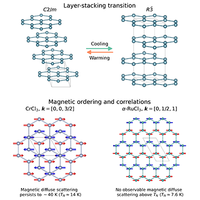
Contrasting structural reversibility and magnetic correlations in isostructural honeycomb magnets CrCl3 and αRuCl3

Zachary Morgan, Iris Ye, Jiasen Guo, Michael A. McGuire, and Jiaqiang Yan

Phys. Rev. Materials 10, 094001 (2026) - Published 3 September, 2026

The layered honeycomb antiferromagnets CrCl₃ and α-RuCl₃ undergo similar first-order, temperature-driven layer-stacking rearrangements, yet respond remarkably differently to thermal cycling. CrCl₃ evolves smoothly through the transition and remains largely reversible, whereas α-RuCl₃ shows an abrupt in-plane lattice discontinuity and accumulates structural disorder upon repeated cycling. Their magnetic correlations are also distinct, with diffuse magnetic scattering in CrCl₃ persisting to ~40 K, well above its ordering temperature, while no comparable quasi-static correlations are observed in α-RuCl₃. These contrasts point to markedly different coupling between layer stacking, strain, and magnetism.

Comprehensive study of exciton luminescence in AlN stacking faults

C. Guérin, J. Cañas, A. Revilla-Martin, F. Jourdan, J. Lähnemann, J. L. Rouvière, B. Daudin, and G. Jacopin

Phys. Rev. Materials 10, 094602 (2026) - Published 3 September, 2026

Dynamic polarity-induced phonon scattering and rattler-like vibrations enable ultralow thermal conductivity and high thermoelectric performance in NaInTe2

Yunfei Wang, Yinchang Zhao, Junping Wang, Jun Ni, and Zhenhong Dai

Phys. Rev. Materials 10, 094603 (2026) - Published 3 September, 2026

Origin of shallow hole traps at GaN/SiO2 interface studied from density functional theory

Yuansheng Zhao, Atsushi Oshiyama, and Kenji Shiraishi

Phys. Rev. Materials 10, L091601 (2026) - Published 3 September, 2026

Systematic global structure search of bismuth-based binary systems under pressure using machine learning potentials

Hayato Wakai, Shintaro Ishiwata, and Atsuto Seko

Phys. Rev. Materials 10, 093801 (2026) - Published 2 September, 2026

Sign In to Your Journals Account

Filter

Recent Issues

Vol. 10, Iss. 9
September 2026
Vol. 10, Iss. 8
August 2026
Vol. 10, Iss. 7
July 2026
Vol. 10, Iss. 6
June 2026
Category
Article Type
Section

Filter

Article Lookup

Enter a citation