Highlights

Direct observation of nanoindentation-induced punching-out of prismatic dislocation loops in tungsten

Florian Tropper and Takahito Ohmura

Phys. Rev. Materials 10, L090601 (2026) - Published 14 September, 2026

The authors have successfully induced and characterized a channel-like deformation mechanism in pure tungsten, providing a new experimental pathway to evaluate irradiation damage in future nuclear fusion reactors. While this phenomenon, where atomic layers slide rigidly like a solid cylinder being forced through a tight tube, is known to occur as a destructive byproduct of intense radiation inside fusion environments, it has previously been highly difficult to isolate and study in a controlled manner. In this work, they overcame this challenge by precisely pressing a microscopic tip into a specifically oriented tungsten single-crystal. Using advanced electron microscopy techniques, they studied the resulting atomic displacements and determined the channel-like deformation for the first time in this crystal structure. This opens a new avenue to study defect formation and propagation, critical for understanding fundamental plastic yielding and analyzing structurally identical irradiation-induced defects.

How SISSO-derived materials genes shape materials properties: An analytical sensitivity analysis

Lucas Foppa and Matthias Scheffler

Phys. Rev. Materials 10, 093601 (2026) - Published 8 September, 2026

Symbolic regression tools like SISSO can model materials properties as compact analytical formulas depending on key physical parameters. In this contribution, a derivative-based sensitivity analysis is used to quantify how strongly each selected physical parameter drives a SISSO model’s predictions. Applied to the equilibrium lattice constant of perovskites, this approach pinpoints valence orbital radii, nuclear charges, and their products as the most important governing quantities. The partial-effects method offers a computationally efficient, physically intuitive alternative to techniques like SHAP for interpreting symbolic-regression models.

Spin Hall effect in van der Waals ferromagnet Fe5GeTe2

T. Ohta, Y. Samukawa, N. Jiang, Y. Niimi, K. Yamagami, Y. Okada, Y. Otani, and K. Kondou

Phys. Rev. Materials 10, 094002 (2026) - Published 8 September, 2026

We investigate the spin Hall effect (SHE) in a van der Waals (vdW) ferromagnet Fe5GeTe2 (FGT) with a Curie temperature TC of 310 K utilizing the spin-torque ferromagnetic resonance method. The effective spin Hall conductivity is clearly enhanced with decreasing temperature, unlike the anomalous Hall conductivity, reflecting the variation in the band structure accompanied by the complicated magnetic ordering of the FGT. The results provide a deep understanding of the SHE in magnetic materials to open a new route for novel functionalities in vdW materials-based spintronic devices.

Sluggish phase-transition kinetics and extended critical correlations in relaxor ferroelectrics

Masato Matsuura, Kenji Ohwada, Shinya Tsukada, Akihiko Machida, Tatsuya Kikuchi, and Young-Soo Han

Phys. Rev. Materials 10, L091402 (2026) - Published 8 September, 2026

Why do relaxor ferroelectrics exhibit giant dielectric and piezoelectric responses over such a broad temperature range? By combining rapid-cooling synchrotron x-ray diffraction with neutron scattering, this work shows that phase transitions in PMN-xPT are remarkably sluggish and can even be bypassed by fast cooling. At the same time, the polar nanoregions display scale-free critical correlations in both space and time over the temperature range where the giant response appears. These results suggest that slow phase-transition kinetics sustain an extended critical state, providing a new physical picture for the origin of giant relaxor responses.

Experimental three-dimensional dendrite tip shape characterization by interferometry and phase-field comparison during columnar directional solidification

Mehdi Medjkoune, Trevor Lyons, Fatima L. Mota, Jiefu Tian, Kaihua Ji, Louise Littles, Alain Karma, and Nathalie Bergeon

Phys. Rev. Materials 10, 093401 (2026) - Published 4 September, 2026

Machine learning interatomic potentials for solid-state precipitation

Lorenzo Piersante and Anirudh Raju Natarajan

Phys. Rev. Materials 10, 093802 (2026) - Published 4 September, 2026

Machine-learning interatomic potentials now model complex alloys with near ab initio precision, but two challenges persist. Researchers must generate training data tailored to the physical process of interest, and they need validation metrics that go beyond simple statistical errors. Here the authors introduce a crystal-symmetry-based enumeration scheme for structural phase transformations in multicomponent alloys and a semi-grand-canonical Kendall-τ that quantifies thermodynamic accuracy across composition. These tools yield a general-purpose Mg-Nd potential. Simulations reveal a subtle interplay between chemical ordering and structural rearrangement and elucidate the continuous hcp-to-bcc transition underlying precipitation in this alloy.

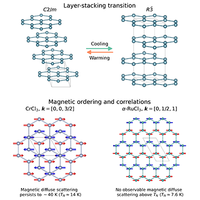
Contrasting structural reversibility and magnetic correlations in isostructural honeycomb magnets CrCl3 and αRuCl3

Zachary Morgan, Iris Ye, Jiasen Guo, Michael A. McGuire, and Jiaqiang Yan

Phys. Rev. Materials 10, 094001 (2026) - Published 3 September, 2026

The layered honeycomb antiferromagnets CrCl₃ and α-RuCl₃ undergo similar first-order, temperature-driven layer-stacking rearrangements, yet respond remarkably differently to thermal cycling. CrCl₃ evolves smoothly through the transition and remains largely reversible, whereas α-RuCl₃ shows an abrupt in-plane lattice discontinuity and accumulates structural disorder upon repeated cycling. Their magnetic correlations are also distinct, with diffuse magnetic scattering in CrCl₃ persisting to ~40 K, well above its ordering temperature, while no comparable quasi-static correlations are observed in α-RuCl₃. These contrasts point to markedly different coupling between layer stacking, strain, and magnetism.

Element- and atomic-layer-resolved detection of surface magnetism via x-ray-excited tunneling

Sineth Premarathna, Kyaw Zin Latt, Nozomi Shirato, Sarah Wieghold, Daniel Rosenmann, Alex Taekyung Lee, Anh T. Ngo, Volker Rose, and Saw Wai Hla

Phys. Rev. Materials 10, L091401 (2026) - Published 1 September, 2026

Magnetism sensitive only to the outermost atomic layer of a material is difficult to detect by x-rays. This is demonstrated using synchrotron x-ray scanning tunneling microscopy in spectroscopic mode, which simultaneously measures ensemble-averaged and surface-atomic-layer magnetism in an ultrathin Ni film. X-ray magnetic circular dichroism reveals an enhancement of orbital and spin magnetic moments in the outermost layer relative to the film average. This work opens a new experimental route for quantitative, element-specific magnetometry with atomic-layer sensitivity.

Efficient creation of shallow NV ensembles by high-angle ion implantation

Kento Sasaki, Hideyuki Watanabe, Tokuyuki Teraji, Takashi Taniguchi, Kenji Watanabe, and Kensuke Kobayashi

Phys. Rev. Materials 10, 086202 (2026) - Published 11 August, 2026

Nitrogen-vacancy centers in diamond are widely used as quantum sensors, but creating shallow ensembles with high yield and reasonable spin coherence remains challenging. We show that high-angle nitrogen ion implantation efficiently forms shallow NV ensembles. Implanting ions at angles above 60° gives NV yields approaching 10% with effective depths below 10 nm. The oblique geometry enhances near-surface vacancy generation while keeping nitrogen close to the surface, improving the conditions for NV formation. The resulting ensembles retain stable charge states and useful spin coherence, offering a practical platform for nanoscale NMR and NQR sensing.

Charge-to-spin conversion in epitaxial and polycrystalline Bi and Bi/Ag layers

Federica Nasr, Emir Karadža, Santos F. Alvarado, Federico Binda, Tobias Goldenberger, Carlo Zucchetti, Myriam H. Aguirre, Paolo Moras, Andrey V. Matetskiy, Polina M. Sheverdyaeva, Paul Noël, and Pietro Gambardella

Phys. Rev. Materials 10, 074406 (2026) - Published 9 July, 2026

Bismuth is a promising spin current generator owing to its strong spin–orbit coupling, spin-polarized surface states, and large intrinsic spin Hall conductivity predicted by theory. Yet experimental reports of spin–charge interconversion efficiencies remain remarkably inconsistent. The authors compare structural, spectroscopic, and spin–orbit torque measurements of epitaxial and polycrystalline Bi layers in combination with different metal spacers and ferromagnets. The results reveal extensive interdiffusion and dewetting unless Ag overlayers are used to preserve the structural and chemical integrity of Bi, unlocking a giant bulk spin Hall angle exceeding unity and highlighting the potential of Bi for spintronic applications.

Facilitating electrical and laser-induced skyrmion nucleation with a dipolar-field-enhanced effective Dzyaloshinskii-Moriya interaction

Mark C. H. de Jong, Dinar Khusyainov, Julian Hintermayr, Bart Sanders, Dmitry Kozodaev, Aleksei V. Kimel, Bert Koopmans, Theo H. M. Rasing, and Reinoud Lavrijsen

Phys. Rev. Materials 10, 064415 (2026) - Published 29 June, 2026

Magnetic skyrmions are promising nanoscale information carriers, but creating them efficiently remains a central challenge. Here the authors show that a multilayer’s own dipolar field can be turned from a complication into a design tool. By reversing the Ir/Co/Pt stacking order in half of the film, the layer-resolved Dzyaloshinskii–Moriya interaction is made to work with, rather than against, the dipolar field. This dipolar-field-enhanced effective DMI enables both nanosecond current pulses and femtosecond laser pulses to generate up to twenty times denser, more stable skyrmion populations—without substantially changing the nucleation threshold.

Tailoring ultrathin magnetic multilayers at terraced topologically insulating interfaces for perpendicularly magnetized domains

Benjamin A. Brereton, Soumyarup Hait, Ahmet Yagmur, Christy J. Kinane, Francesco Maccherozzi, Michele Conroy, Satoshi Sasaki, Thomas A. Moore, Sarnjeet S. Dhesi, Sean Langridge, and Christopher H. Marrows

Phys. Rev. Materials 10, 064413 (2026) - Published 24 June, 2026

Topological insulators are known for their highly efficient spin-to-charge conversion, capable of exerting spin-orbit torques in adjacent magnetic multilayers, yet their usefulness in the manipulation of spin textures remains largely unexplored. This work describes the optimization process of a combined topological insulator-magnetic multilayer heterostructure where, through the minimization of the density of characteristic Bi2Se3 surface terraces and the insertion of a refractory metal buffer layer, conventional magnetic multilayers with full perpendicular magnetic anisotropy can be grown. Labyrinthine, zero-field domains de-pinned from the TI topography are observed, raising the possibility of future, highly efficient electrical control of hosted spin textures.

Interfacial control of orbital occupancy and spin state in LaCoO3

Ellen M. Kiens, Nicolas Gauquelin, Arno Annys, Emma van der Minne, Iris C. G. van den Bosch, Matthijs A. van Spronsen, Zezhong Zhang, Annick De Backer, Sandra Van Aert, Jo Verbeeck, Gertjan Koster, Bastian Mei, Frank M. F. de Groot, and Christoph Baeumer

Phys. Rev. Materials 10, 066003 (2026) - Published 22 June, 2026

Interfacial engineering offers a powerful route to control electronic states in correlated oxides. Here, the authors demonstrate tunable Co 3d orbital occupancy in LaCoO3 heterostructures, spanning partial d5 to d7 configurations via tailored interfaces with LaTiO₃, LaMnO₃, LaNiO₃, and LaAlO₃. Combining X-ray absorption spectroscopy with multiplet calculations reveals interface-dependent charge transfer and spin-state modulation, while atomic-scale microscopy links these effects to strain and structural distortions. Notably, inserting a LaAlO₃ spacer suppresses charge transfer, stabilizing an unexpected low-spin d6 state. These findings highlight how interfacial design governs orbital occupation and spin, providing a versatile platform for tuning functionality in oxide electronics and catalysis.

Deformation regimes in soft materials under large amplitude oscillatory shear

Rishav Agrawal, Patrick T. Spicer, and Esther García-Tuñón

Phys. Rev. Materials 10, 065604 (2026) - Published 11 June, 2026

The deformation and flow of complex soft materials are ubiquitous both in nature and across many industrial applications, such as landslides, extrusion flows, and additive manufacturing. This paper reconciles bulk rheological measurements with microscopic dynamics to elucidate complex deformation pathways and fracture events in concentrated suspensions embedded in a hard gel matrix. The results demonstrate that the deformation of such composites is complex, where heterogeneous yielding and fracture coexist and negatively impact shape fidelity in direct ink writing. Rheo-microscopy enables the establishment of a phase diagram to map concentration-dependent deformation regimes and define the boundaries between affine deformation, banding, and fracture.

Competing phases and domain structures of ferroelectric perovskites: The benefit of epitaxial (110) growth

Lan-Tien Hsu, Takeshi Nishimatsu, and Anna Grünebohm

Phys. Rev. Materials 10, 064405 (2026) - Published 8 June, 2026

Epitaxial strain is a powerful route for engineering ferroelectric phases, yet the role of film orientation remains largely underexplored. Using first-principles-based molecular dynamics, we show that biaxial (110) strain can stabilize a rich variety of nanoscale states, including unusual domains, heterophases, superdomains, and antiferroelectric-like ordering, in the chemically simple perovskites BaTiO3, KNbO3, and PbTiO3. These metastable configurations, persisting across broad strain–temperature ranges, not only point to promising opportunities for large and adaptive functional responses, but also highlight the importance of symmetry breaking by film orientation in ferroelectric materials design.

Fracture initiation in silicate glasses via a universal shear localization mechanism

Matthieu Bourguignon, Gustavo Alberto Rosales-Sosa, Yoshinari Kato, Bruno Bresson, Hikaru Ikeda, Shingo Nakane, Gergely Molnár, Hiroki Yamazaki, and Etienne Barthel

Phys. Rev. Materials 10, 065603 (2026) - Published 8 June, 2026

Linking crack initiation in silicate glasses to shear banding identifies shear localization as a key driver of fracture in this archetypal brittle material. The results unify network glasses with other families of amorphous solids, such as bulk metallic glasses and glassy polymers, by exposing common mechanisms of plastic deformation. This universality calls for a general theory of flow and failure in amorphous solids.

Magnetic pair breaking and local lattice distortion in Cr-containing high-entropy alloy superconductors

Nikita Sharma, Tirthankar Chakraborty, and Sourav Marik

Phys. Rev. Materials 10, 064803 (2026) - Published 4 June, 2026

High-entropy alloy superconductors provide a unique platform to explore the interplay between disorder, lattice distortion, and superconductivity. Here, the author investigate the effect of incorporating the magnetic element Cr in a high entropy alloy superconductor (TiVTa)0.6Nb0.4xCrx, revealing a systematic suppression of superconductivity despite nearly constant valence electron count. We show that magnetic impurity scattering drives pair breaking consistent with Abrikosov–Gor’kov theory in this highly disordered system, while strong local lattice distortion coexists with long-range crystalline order.

Magnetic phase diagram and spin Hamiltonian of antiferromagnet Cs2CoI4

S. D. Nabi, L. Facheris, V. Romerio, V. Kocsis, K. Yu. Povarov, D. Sheptyakov, J. Lass, D. G. Mazzone, H. Kikuchi, T. Masuda, S. A. Barnett, D. R. Allan, Z. Yan, S. Gvasaliya, and A. Zheludev

Phys. Rev. Materials 10, 054420 (2026) - Published 29 May, 2026

The S=3/2 compound Cs2CoI4 is a new member of the celebrated family of frustrated magnets Cs2MX4 (M = transition metal ion; X = halogen or oxygen). Thermodynamic and neutron scattering measurements reveal a complex magnetic phase diagram and excitation spectrum markedly different from related compounds. A structural phase transition is central to understanding this behavior. Based on the solved low-temperature crystal structure, a spin Hamiltonian is constructed that captures the observed spin dynamics and provides a qualitative understanding of the phase diagram.

Relativistic effects in LaBi2 thin films

Reiley Dorrian, Sungmin Song, Jinwoong Kim, Mizuki Ohno, Seung-Hoon Jhi, Nicholas Kioussis, and Joseph Falson

Phys. Rev. Materials 10, 053401 (2026) - Published 21 May, 2026

Relativistic spin-orbit coupling (SOC) is an important ingredient for discovering novel electronic phenomena in quantum materials. In this work, the authors investigate the consequences of strong SOC on the physical properties of the LaPn2 (Pn = Sb, Bi) class of layered square-net materials via the synthesis of LaBi2 thin films. They report a layer-by-layer growth mode, a previously mis-indexed monoclinic structure type, and classify the compound as a good metal displaying superconductivity at ~0.55 K. Compared to LaSb2, density functional theory calculations attribute the enhanced metallic behavior and growth dynamics of LaBi2 to significant relativistic corrections to its electronic band structure.

Seamlessly joining length scales: From atomistic thermal graphs to anisotropic continuum conductivity

C. Ugwumadu, D. A. Drabold, and R. M. Tutchton

Phys. Rev. Materials 10, 053804 (2026) - Published 21 May, 2026

From Atoms to Devices: SCACS, Bridging the Longstanding Scale Gap in Heat Transport SCACS (Simulator Collection for Atomic-to-Continuum Scales) is a first-of-its-kind simulation framework that connects atomic-scale material structure directly to device-scale predictions of heat flow. This solves a longstanding problem in science and engineering: how to use atomic-level information to predict the behavior of real materials and devices. Statistical mechanics is a classic example of linking microscopic physics to large-scale properties such as temperature and pressure. In a similar spirit, SCACS links atomic, mesoscopic, and macroscopic descriptions of thermal transport in a continuous and practical way. The method starts from atomistic information, preserves the effects of defects, interfaces, and disorder, and transfers that information into engineering-scale heat-flow simulations. A machine-learning model is used as a computational tool to extend these predictions to much larger systems than would otherwise be practical. The result is a new route for carrying atomic-scale thermal physics into device-scale models, with potential value for designing semiconductors, energy materials, and other technologies where heat management is critical.

Sign In to Your Journals Account

Filter

Section

Filter

Article Lookup

Enter a citation