
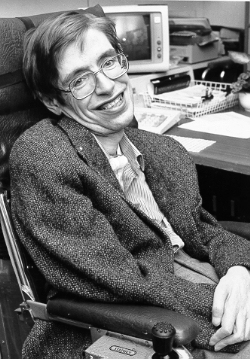
Many people have heard of Stephen Hawking, the “genius in a wheelchair”, but far fewer know what he did and what he was like. I was his post-doctoral fellow for two and a half years, and so I am able to comment a bit both on his work and on other aspects of his life.
Stephen’s first big breakthrough was the realization that Penrose’s theorems about the inevitability of singularities in black holes in Einstein’s Theory of Gravitation could be applied in reverse to imply the inevitability of the Big Bang singularity and the beginning of time. His next, and most important, breakthrough was the realization that due to quantum effects, black holes are not black — they emit what is now called Hawking Radiation. This shocking discovery implied that, despite the many orders of magnitude of scale that separated them, Einstein’s theory could not ignore the quantum world.
In 1979, Stephen hired me to teach him about supergravity, the remarkable extension of Einstein’s theory that Peter van Nieuwenhuizen, Daniel Freedman, and Sergio Ferrara had discovered two years earlier at Stony Brook — later I learned that Stephen hired me on Peter’s recommendation. Though I failed to teach Stephen supergravity, it was nevertheless a very productive time for Stephen. During this time, among many other projects, he explored the effects of gravitational instantons and the consequences of his then recently proposed Information Paradox [1]; though his argument that Hawking Radiation implied the breakdown of quantum mechanics is generally not accepted today (Stephen himself rejected it later in life), it stimulated a wealth of important research, some of which is described in Leonard Susskind’s entertaining book The Black Hole War: My Battle with Stephen Hawking to Make the World Safe for Quantum Mechanics.
My time with Stephen’s group let me see some things that are not as well known. He always had a number of students and postdocs with him. He would work with them by asking them to write equations on the blackboard — at that time he was already confined to a motorized wheel chair and could not write himself, but he could still speak, albeit with such difficulty that only those who spent a lot of time with him could understand him. Nonetheless, he had a sharp sense of humor, and despite the effort it took, made jokes and displayed his knowledge in areas outside of physics — at a dinner where I was feeding him, he explained to me the proper way to fillet a braised trout; since a bone could have been quite dangerous to him, I had to be a quick learner. He tried to lead a normal life, with the necessary accommodation for his physical condition. Thus driving his wheelchair by himself was “walking”, etc. He spent time with his children, he went with the group for lunch at the “grad-pad”, went to the pub with us, and so on. All the students and postdocs did their part in helping to make this possible; he would tell us what we should and shouldn’t do to help him.
Stephen would go on to propose that the universe began with a quantum fluctuation that replaced the singularity of the Big Bang, and many other important and thought-provoking ideas. He was a great mentor: many of his students and postdocs went on to very successful academic careers. He was a role model for those overcoming physical adversity, and through his many books, a great popularizer of physics and science in general.
He will be missed.
[1] This article and all others published by Stephen Hawking published in the Physical Review journals have been made free to read online. Among them one can find the Wave function of the Universe, which describes quantum aspects of the Big Bang.
Martin Rocek, YITP Stony Brook University
