Highlights

Fermi surface studies of altermagnetic CrSb from Shubnikov–de Haas oscillations

Sajal Naduvile Thadathil, Beat Valentin Schwarze, Jaafar Ansari, Tommy Kotte, Sven Luther, Marc Uhlarz, Freya Husstedt, Rafael Gonzalez-Hernandez, Libor Šmejkal, Thanassis Speliotis, Markéta Žáčková, Jiří Pospíšil, Christoph Müller, Dominik Kriegner, Helena Reichlová, Jochen Wosnitza, and Toni Helm

Phys. Rev. B 114, 185104 (2026) - Published 3 September, 2026

The authors present here results from electrical magnetotransport measurements on microstructures of altermagnetic CrSb in pulsed fields up to 68 T. They study the temperature and field-orientation dependence of magnetic quantum oscillations in combination with first-principles calculations. The observed frequency spectrum agrees well with density functional theory calculations that take spin-orbit coupling into account, without invoking significant ad hoc band shifts. The findings validate the predicted electronic band structure of CrSb hosting multiple semimetallic bands and a locally alternating spin polarization.

Optical spin precession

Abanoub Mikhail, Maxim Mazanov, Ilya Deiry, Mingzhao Song, Ivan Iorsh, and Andrey Bogdanov

Phys. Rev. B 114, 154403 (2026) - Published 2 September, 2026

Here, optical spin angular momentum is extended to nonmonochromatic electromagnetic fields, revealing that specific polychromatic configurations exhibit photonic spin precession governed by a Landau–Lifshitz-like equation. A precessing magnetic dipole realizes source-driven spin dynamics in the near field, while bichromatic two-wave interference additionally produces nutation. A generalized spin-continuity equation shows how sources act on optical spin through torque, establishing a direct link between photonic spin and magnetization dynamics.

Orthogonal excitation polarization dictated by site symmetry in upconversion luminescence of βNaYF4:Er3+ microrods

Liji Wang, Yan Liu, Siyu Guo, Long Zhang, Zhanghai Chen, Guanying Chen, and Ai-Hua Li

Phys. Rev. B 114, 165403 (2026) - Published 2 September, 2026

Here, the authors build a symmetry-based framework for rare-earth upconversion luminescence via deterministic polarization correlations among sequential absorption steps, previously assumed to be uncorrelated. Using polarization-resolved spectroscopy and crystal field modeling, they assign full Stark levels and irreducible representations for Er3+ in β-NaYF4 microrods and identify an approximate C3 site symmetry. Since excited-state absorption inherits ground-state polarization constraints, both downshifting and upconversion luminescence exhibit excitation-wavelength-tunable, region-selective orthogonal excitation polarization responses.

Class C quantum network model with random tunneling and its nonlinear sigma model representation

D. S. Katkov, M. V. Parfenov, and I. S. Burmistrov

Phys. Rev. B 114, 185405 (2026) - Published 2 September, 2026

The spin quantum Hall effect is the superconducting counterpart of the integer quantum Hall effect. Here, the authors derive the long-distance nonlinear sigma model for a quantum network with random tunneling between chiral links carrying N channels. Strong even–odd tunneling asymmetry breaks the saddle point down. Also, the triplet sector stays coupled to the singlet one and can turn anomalously soft. The longitudinal and spin Hall conductances can be tuned independently, giving a flexible platform for class-C localization.

Isotropic superconductivity in the room-temperature superconductor LaSc2H24

Zefang Wang, Wenbo Zhao, Yuan Ma, Hanyu Liu, and Yanming Ma

Phys. Rev. B 114, 154501 (2026) - Published 1 September, 2026

Why does LaSc2H24 exhibit superior superconductivity compared with LaH10? Here, the authors indicate that scandium not only distorts the hydrogen cage structure but also creates MgB2-like Sc-H states at the Fermi level. This synergy enhances electron-phonon coupling, unifies strongly coupled H-H states with widely distributed Sc-H states on the Fermi surface, and leads to isotropic single-gap superconductivity with a higher superconductivity.

Metallic crossover through the tilt-free transition in La3Ni2O7 at high pressure and temperature

Bastien Michon, Yingpeng Yu, Beatrice D'Alò, Elena Stellino, Gergely Németh, Bosen Wang, Jianping Sun, Jinguang Cheng, Paolo Postorino, Ferenc Borondics, and Francesco Capitani

Phys. Rev. B 114, L140102 (2026) - Published 1 September, 2026

Here, the authors map the temperature-pressure evolution of the bilayer nickelate La3Ni2O7 and reveal that the suppression of tilts in oxygen octahedra is accompanied by a pronounced crossover toward a higher-carrier-density metallic state. By establishing the structural phase boundary over a broad temperature-pressure range, their results highlight the intimate interplay between lattice structure and electronic properties in this novel high-Tc superconductor.

Observation of subharmonic charge-density-wave correlations in La-based cuprates

J.-S. Lee, S. A. Kivelson, H. Lee, T. Wang, Y. Ikeda, T. Taniguchi, C.-T. Kuo, M. Fujita, and C.-C. Kao

Phys. Rev. B 114, 074514 (2026) - Published 31 August, 2026

Suggestive but indirect evidence for pair-density-wave correlations has been reported in several high-Tc cuprates, yet a bulk-sensitive scattering signature of the expected subharmonic charge response has remained elusive. Here, the authors use resonant soft x-ray scattering to identify a reproducible subharmonic charge density wave response near half the primary charge-ordering wave vector in two La-based cuprates. The response emerges in the stripe-ordered, layer-decoupled superconducting regime, where charge, spin, and superconducting correlations are intertwined.

Magnetoelasticity in Fe/GaAs(110) films: Depth profile of magnetic anisotropy

Aleksandra Lindner, Rodolfo A. Gallardo, Andreas Henschke, Fabian Ganss, Javier Pablo-Navarro, Gabriel Gray, Ruslan Salikhov, Kilian Lenz, Toni Hache, Dirk Sander, Gauravkumar Patel, Sebastian Fähler, Olav Hellwig, Jürgen Fassbender, and Jürgen Lindner

Phys. Rev. B 114, 094438 (2026) - Published 31 August, 2026

The authors report here the coexistence of cubic and uniaxial magnetic anisotropies in thick epitaxial bcc Fe(110)/GaAs(110) films, with the latter having a magnitude comparable to that of the former. Their interplay stabilizes an in-plane easy axis along the ⟨001⟩ directions that persists throughout the film volume for thicknesses up to 100 nm. This unconventional behavior gives rise to a depth-dependent magnetic response, with perpendicular standing spin-wave modes exhibiting distinct sensitivities to different regions of the film thickness. The study further identifies anisotropic strain as the microscopic origin of the observed in-plane uniaxial anisotropy.

Topological gyromorphs

Laura Gómez Paz, Justin Schirmann, Adam Yanis Chaou, Isidora Araya Day, and Adolfo G. Grushin

Phys. Rev. B 114, L080201 (2026) - Published 31 August, 2026

Gyromorphs are disordered structures that retain quasi-long-range rotational order. They support unusually large, isotropic photonic band gaps, making them promising for technological applications. Here, the authors show that gyromorphs host higher-order topological insulating phases protected by rotational symmetry realized only on average, precisely where standard real-space diagnostics become ambiguous. They develop a diagnostic toolbox for average rotational symmetries that yields a consistent phase diagram, establishing gyromorphs as a new platform for statistical-symmetry-protected topology beyond crystals and quasicrystals.

Proof of the absence of local conserved quantities in general spin-12 chains with symmetric nearest-neighbor interaction

Mizuki Sanatani, Yuuya Chiba, and Naoto Shiraishi

Phys. Rev. B 114, 094437 (2026) - Published 28 August, 2026

Integrable quantum spin chains are distinguished by infinitely many nontrivial local conserved charges, whereas generic systems are expected to have none. Here, the authors prove this expectation for spin-½ chains with symmetric nearest-neighbor interactions. Outside the known integrable families, no model has even one such charge. Thus, within this class, there is no intermediate possibility: a chain is either in a known integrable family, with infinitely many such charges, or has none.

Eightfold classification of superconducting orders

Alexander V. Balatsky and Saikat Banerjee

Phys. Rev. B 114, 074511 (2026) - Published 27 August, 2026

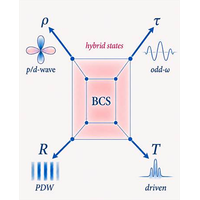
Superconductivity begins when electrons bind into pairs. Because electrons are fermions, exchanging the two partners in a pair must flip the sign of its wavefunction — and that minus sign can be paid for in four different currencies: the pair’s spin, its spatial shape, its orbital character, and, less obviously, the relative time between the two electrons. Sharing one minus sign among four ± choices leaves exactly eight allowed kinds of Cooper pair. Balatsky and Banerjee show here that this eightfold rule is one face of a larger structure. A pair also has a center of mass — a place and a moment — and a superconductor can order in those as well. Taking internal shape (ρ), internal timing (τ), spatial modulation (R), and temporal modulation (T) as four independent axes builds the Berezinskii–Abrahams hypercube: a sixteen-corner map of superconducting order. BCS sits at the origin; each single axis recovers a familiar family — p- and d-wave gaps, odd-frequency pairing, FFLO and pair-density waves, driven superconductors. The corners in-between are hybrids. A few have been touched; most are empty, and the far corner, with all four switched-on at once, has never been visited. The hypercube is at once a classification and a search map.

Spin-Hall angle temperature dependence in NiFe/MnBi2Te4 heterostructures

A. S. Pakhomov, V. V. Yurlov, P. N. Skirdkov, M. V. Bakhmetiev, R. B. Morgunov, N. T. Hai, J. C. Wu, J. C. A. Huang, S. H. Su, C. F. Almeida Alves, E. Paz, A. I. Chernov, and K. A. Zvezdin

Phys. Rev. B 114, 074433 (2026) - Published 26 August, 2026

Pairing a ferromagnet with the MnBi2Te4 offers a promising route to efficient spin-to-charge conversion, but how well it performs across temperature had remained unmapped. Combining ferromagnetic resonance with inverse spin-Hall voltage measurements from 20–290 K, the authors show here that the spin-Hall angle stays nearly constant below approximately 130 K, then becomes unreliable as spin rectification and shifting damping take over. The results establish the material as a robust platform for cryogenic spin-orbit and topological spintronics.

Simplex crystal ground state and magnetization plateaus in the spin-12 Heisenberg model on the ruby lattice

Pratyay Ghosh and Frédéric Mila

Phys. Rev. B 114, 074435 (2026) - Published 26 August, 2026

The authors demonstrate here that the antiferromagnetic spin-½ Heisenberg model on the ruby lattice with second-neighbor interactions realizes a simplex valence-bond crystal state. Although singlet formation on the hexagonal plaquettes of the lattice appears to be a natural choice, the system instead selects simplices composed of two neighboring triangles. An effective spin-chirality description reveals how the interplay of spin and chiral degrees of freedom associated with individual triangles stabilizes simplex-based crystal order.

Confinement-dependent exciton and biexciton dynamics in bright band-gap-emitting AgInS2 quantum dots

Julian G. Mann, Johannes Kunze, Nivedita Pan, Ekaterina Kostyurina, Markus Döblinger, Bert Nickel, Jochen Feldmann, and Sushant Ghimire

Phys. Rev. B 114, 125420 (2026) - Published 26 August, 2026

Here, the authors uncover size-dependent exciton formation and biexciton dynamics in AgInS2 quantum dots, an environmentally friendly I-III-VI semiconductor alternative. Exciton formation proceeds through phonon-mediated inter-valence-band hole relaxation. This process becomes progressively slower with decreasing quantum dot size, in contrast to the Coulomb-mediated relaxation characteristic of II-VI quantum dots. These dynamics govern the emergence of distinct exciton-to-biexciton transitions. The biexciton lifetime increases with crystallite size, with the largest quantum dots exhibiting partial biexciton emission.

Quintic-anharmonicity-assisted three-phonon scattering: A previously overlooked same-order channel to four-phonon scattering

Yi Xia

Phys. Rev. B 114, L111202 (2026) - Published 26 August, 2026

Four-phonon scattering is widely viewed as the leading higher-order correction to anharmonic phonon dynamics. Here, the authors identify a previously overlooked scattering channel, in which cubic and quintic anharmonicity combine to produce three-phonon-like scattering at the same perturbative order. First-principles calculations show that this mechanism rivals four-phonon scattering in silicon and can approach ordinary three-phonon scattering in strongly anharmonic AgCl, reshaping the microscopic picture of lattice dynamics and thermal transport.

Phase control of magnon-phonon coupling via magnetic field

Yasuhiro Todaka, Motoki Asano, Isamu Yasuda, Masashi Kawaguchi, Daiki Hatanaka, and Masamitsu Hayashi

Phys. Rev. B 114, 084426 (2026) - Published 25 August, 2026

Magnon-phonon coupling has attracted considerable interest because of its potential applications in hybrid quantum systems and magnonic devices. Here, the authors show that the coupling constant evolves from real to complex as the external magnetic field is reduced, thereby causing a pronounced minimum in phonon transmittance near zero field. The results demonstrate that the phase and magnitude of the complex coupling constant can be tuned with magnetic field in strongly damped magnets, offering a platform for exploring novel regimes of magnon-phonon interaction.

Demagnetization effect on magnetic noise measurements in spin ice materials

F. Morineau, C. Paulsen, G. Balakrishnan, D. Prabhakaran, K. Matsuhira, S. R. Giblin, and E. Lhotel

Phys. Rev. B 114, 094433 (2026) - Published 25 August, 2026

Magnetic noise spectroscopy provides direct access to spontaneous magnetization fluctuations in correlated magnetic systems. Here, the authors investigate how demagnetizing fields influence magnetic noise spectra. By combining magnetic noise and ac susceptibility measurements across samples of different sizes and shapes, they show that sample geometry plays a decisive role in the measured fluctuations and must therefore be treated as a key experimental control parameter when probing intrinsic dynamics. Their results underscore the importance of boundary conditions and establish a framework for quantitatively comparing magnetic noise measurements with microscopic theories.

Sizable ligand-mediated bond-dependent interactions in the spin-1 triangular antiferromagnet NiI2

Hao Xu, Weiqin Zhu, Shufan Cheng, Yanyan Shangguan, Song Bao, Junbo Liao, Bo Zhang, Zihang Song, Shuai Dong, Maofeng Wu, Stanislav E. Nikitin, Travis J. Williams, Changsong Xu, and Jinsheng Wen

Phys. Rev. B 114, L080405 (2026) - Published 25 August, 2026

Kitaev interaction can generate unusual quantum states and is usually sought in compounds with strongly spin-orbit-coupled magnetic ions. Here, the authors combine neutron scattering with calculations of magnetic structure and excitations to establish sizable Kitaev and off-diagonal interactions in the spin-1 triangular magnet NiI2, with spin-orbit coupling supplied instead by surrounding iodine atoms. These interactions stabilize its canted proper-screw order and open an excitation gap. This finding extends the search for Kitaev physics into high‑spin systems with intrinsically weak ionic spin–orbit coupling.

High harmonic spectroscopy from lower-order to higher-order topological insulators

Bryan Lorenzo, Carlos Batista, Milad Jangjan, Dasol Kim, Jean Menotti, Feng Liu, Wenlong Gao, Shambhu Ghimire, Camilo Granados, and Alexis Chacón

Phys. Rev. B 114, 084307 (2026) - Published 24 August, 2026

Here, the authors demonstrate that high-harmonic spectroscopy from lower-order to higher-order topological insulators reveals distinct contributions from bulk, edge, and corner electronic states. By systematically resolving these emission channels, they establish how topological features evolve across different classes of topological materials and clarify the microscopic origin of the emitted harmonics. Their results provide a unified framework for understanding and exploiting high-harmonic generation as a probe of topological quantum matter.

Exciton and biexciton preparation via coherent swing-up excitation in a GaAs quantum dot embedded in a micropillar cavity

Claudia Piccinini, Aleksander Rodek, Abdulmalik A. Madigawa, Ailton Garcia, Jr., Saimon F. Covre da Silva, Martin A. Jacobsen, Luca Vannucci, Gregor Weihs, Armando Rastelli, Vikas Remesh, Niels Gregersen, and Battulga Munkhbat

Phys. Rev. B 114, 105306 (2026) - Published 24 August, 2026

Here, the authors implement the recently proposed Swing-UP of the quantum emitter population (SUPER) scheme to investigate the coherent preparation of exciton and biexciton states in GaAs quantum dots using two red-detuned laser pulses. The experiments show that, by tuning the polarization and energy of the utilized pulses, one can achieve highly efficient preparation of an individual exciton state, a coherent superposition of fine-structure-split exciton states, or the biexciton state, establishing the SUPER scheme as a versatile tool for selective quantum-state preparation.

Sign In to Your Journals Account

Filter

Section

Filter

Article Lookup

Enter a citation