
Toshiyuki Gotoh, Izumi Saito, and Takeshi Watanabe
Phys. Rev. Fluids 6, 110512 (2021) – Published 30 November, 2021

Physical Review Fluids publishes a collection of papers associated with invited talks presented at the mini-symposium on the Cloud Physics at the 73rd Annual Meeting of the APS Division of Fluid Dynamics.
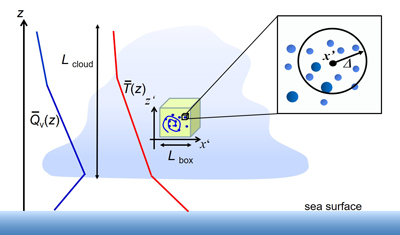
A set of equations for supersaturation (SS) and liquid water content (LWC) fluctuations in cloud turbulence are derived and their spectra are analyzed by using the Lagrangian renormalized approximation. The SS spectrum has three power law ranges, while the LWC spectrum has two power law ranges before the exponential roll off as the wavenumber increases.
Designated a new cloud feature in 2017, asperitas clouds are wave-like formations on the underside of layer clouds. We propose a mechanism for asperitas cloud formation: an instability driven by the settling and evaporation of water droplets. For suitable droplet size and liquid water content, a layer of dense air forms, which in moderate ambient shear gives rise to cloud structures of the asperitas type.
In climate predictions, clouds are the leading source of uncertainty. For both predictions and basic understanding, a main challenge is to account for the vast range of scales, from the scales of individual clouds to the large-scale circulations. Here, an idealized simulation framework is investigated with stochastic clouds, so that some clouds are not subgrid-scale and are instead evolving on the numerical grid, albeit stochastically. The results show the possibility of following the influence of clouds on climate in idealized climate change simulations.
In this article we bridge between the Rayleigh-Bénard convection literature and the atmospheric literature by expressing the governing equations for cloudy convection in a dimensionless form. The governing parameters are Rayleigh, Prandtl, Schmidt, Damköhler, and sedimentation numbers for the cloudy case. We further connect to the atmospheric literature by obtaining an expression for the Nusselt number (dimensionless heat flux) for a cloud–convection system, directly from the conservation equations for temperature and water vapor, and illustrate the microphysics independence through large eddy simulation of an idealized cloudy Rayleigh-Bénard convection flow.
Direct numerical simulation is applied to the Pi Chamber experimental facility to understand droplet growth and activation in the context of moist Rayleigh-Bénard turbulence. While many bulk features of the experimental observations are represented well, the Lagrangian approach to droplet microphysics is used to gain insight where experiments cannot. Common assumptions regarding the activation-deactivation cycle and droplet lifetime are shown to be likely erroneous.
Entrainment is the process by which ambient fluid is incorporated into the flow and remains poorly understood. In cumulus clouds, entrainment governs the altitude attained by the cloud and the resulting droplet size distribution, which together determine the radiative contribution to the global energy balance. The release of latent heat by the condensation of water vapor drives the flow in cumulus clouds, which often resemble a series of isolated parcels of buoyancy, or thermals. Here, using direct numerical simulation (DNS), we study the effects of condensation heating on the entrainment in a moist thermal in contrast with a dry thermal that has no buoyancy sources.


