
Douglas H. Kelley
Phys. Rev. Fluids 6, 070501 (2021) – Published 23 July, 2021

Physical Review Fluids publishes a collection of papers associated with the invited talks presented at the 73nd Annual Meeting of the APS Division of Fluid Dynamics.
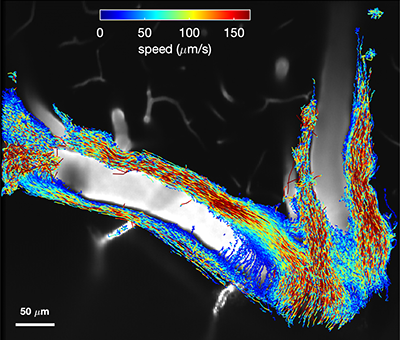
Discoveries of the last decade increasingly support the idea that by flowing through and around the brain, cerebrospinal fluid and other water-like fluids constitute a distinct transport system, important for removing metabolic waste from the brain and relevant to brain injuries. This paper reviews one team’s recent studies of brain cerebrospinal fluid flow. We consider the characteristics of flows and the spaces through which they pass, flow drivers, and application to drug delivery and stroke.
Mixing in fluids is usually thought of as a process of homogenization, but in some circumstances, such as when dealing with filters, particles can have a tendency to accumulate, even at equilibrium. An example is virus particles kept out by a mask: they are more likely to be found near the filter because of a suction effect. A generalization of what we mean by mixing is called for, involving nonuniform, possibly time-dependent ultimate states.
In an effort to achieve very large Rayleigh numbers when studying turbulence on a Rayleigh–Baposenard configuration, one can carry out simulations and experiments in as high convection cells as possible which involves using convection cells with the smallest possible aspect ratio. However, with the increasing height of the cell, the Rayleigh number grows much slower than the critical Rayleigh number for the onset of convection in the same container. This article discusses how to estimate accurately the critical Rayleigh number for the onset of convection in confined geometries and the optimal shape of the container.
Is it possible to reconstruct all the scales of turbulence from limited observations? If so, what is the minimum resolution of observations for a successful reconstruction? How much information about a turbulent flow field can be decoded from an isolated, instantaneous measurement? These fundamental questions are addressed using variational data assimilation, where the observations are infused in simulations and are decoded using the Navier-Stokes equations. We highlight the “dual butterfly effect” and how the stochasticity of turbulence obfuscates the interpretation of measurements.
We develop a wave damping model based on a prediction of current- and wave-induced force on individual plants. The model captures the influence of reconfiguration on wave forces, the impact of current on wave group velocity, and the modification of in-canopy time-mean and wave orbital velocity associated with canopy drag, all of which affect the wave dissipation by vegetation. The model explains why weak current reduces wave dissipation while strong current increases wave dissipation, as observed both in the present and previous studies. Further, we explore the impact of plant flexibility and leaf morphology on wave dissipation over a wide range of current to wave velocity ratio.
The figures on the left show the effect of the Prandtl number (Pr) of the Rayleigh-Bénard problem with Boussinesq conditions, for the same Grashof number of . Top: Pr = 12.73; bottom, Pr = . The plot on the right shows that low molecular Pr yields an inversely varying turbulent Prandtl number; that is, the flow behaves effectively as a high Prandtl number fluid. The data are for non-Boussinesq conditions. The qualitative effect is the same for the Boussinesq case as well, but the dependence has a weaker power law exponent of about .
This article reviews the recent theories and models of space-time energy spectra in turbulent shear flows. The review is based on the picture of turbulent passage proposed by Taylor’s frozen-flow hypothesis and Kraichnan-Tennekes random sweeping hypothesis: convection of small-scale eddies by large-scale eddies with a certain distortion, which determines the peaks and bandwidths of space-time energy spectra. The data-refined stochastic models and data-based reconstruction models are examined. The linearized Navier-Stokes equations with random forcing for space-time energy spectra are also discussed.


