C. Zucchetti, M.-T. Dau, F. Bottegoni, C. Vergnaud, T. Guillet, A. Marty, C. Beigné, S. Gambarelli, A. Picone, A. Calloni, G. Bussetti, A. Brambilla, L. Duò, F. Ciccacci, P. K. Das, J. Fujii, I. Vobornik, M. Finazzi, and M. Jamet
Phys. Rev. B 98, 184418 (2018) - Published 16 November, 2018
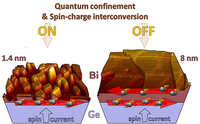
Spin-charge interconversion (SCI) phenomena are now at the core of the field of spin-orbitronics. They allow to generate or detect spin currents in nonmagnetic materials and to manipulate the magnetization of nanomagnets by spin-orbit torque. Here, the authors show that spin-charge interconversion can be tuned by quantum size effects in ultrathin bismuth films. Epitaxially grown on germanium, bismuth first forms nanocrystals with a size less than the electron Fermi wavelength. Quantum confinement in these nanocrystals leads to high bulk resistance which can be interpreted as a semimetal-to-semiconductor transition. They also exhibit metallic surface states with a characteristic helical spin texture at the Fermi contour as shown by spin-resolved photoemission spectroscopy. Hence, when generating a spin current in germanium, it is converted into a charge current uniquely in the bottom surface states of bismuth nanocrystals. When increasing the amount of deposited bismuth, nanocrystals grow and begin to form a continuous semimetallic film suppressing quantum confinement. The spin-to-charge conversions into the top and bottom surfaces cancel each other. Thus, quantum confinement can turn on and off SCI in ultrathin bismuth films.



